
How much tax on investment income Pakistan charges you depends on two things: the product and whether you are on the FBR’s Active Taxpayers List. In 2026-27, filers pay 20% on bank profit, 15% on National Savings, T-bills and most dividends, and 15% on gains from shares bought after 1 July 2024. Non-filers pay roughly double.
This guide puts every rate for tax year 2027 (1 July 2026 to 30 June 2027) in one table, shows what you actually keep on Rs 10 lakh, explains which taxes are final, and lists the legal ways to pay less. It is the tax companion to our guide to the best investment in Pakistan, and every rate here comes from the FBR rate card and the Finance Act 2026.
Last updated: 4 November 2026 by Ahmed.
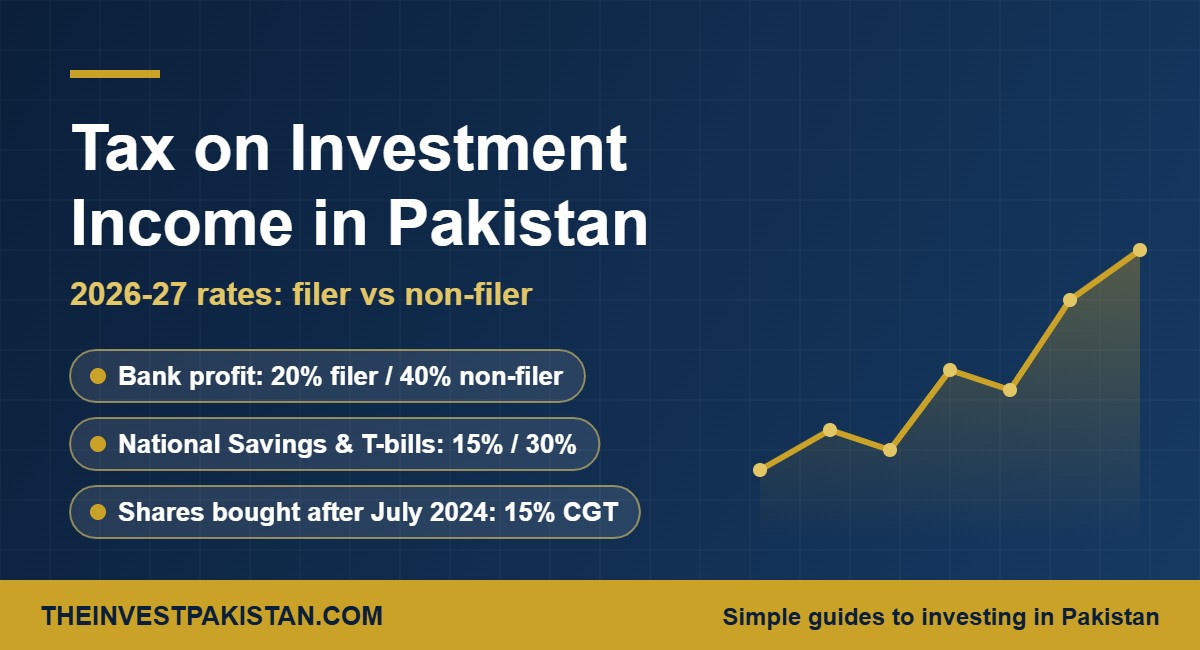
Tax on Investment Income Pakistan 2026-27: Quick Rate Table
“Filer” here means your name is on the FBR’s Active Taxpayers List (ATL). Rates apply to individuals.
| Income | Filer (on ATL) | Non-filer | Law | Final tax? |
|---|---|---|---|---|
| Bank profit (savings accounts, term deposits, Islamic or conventional) | 20% | 40% | Section 151 | Yes, if yearly profit on debt is up to Rs 5 million |
| National Savings certificates and accounts (RIC, DSC, SSC, Sarwa and others) | 15% | 30% | Section 151 | Yes, up to Rs 5 million |
| Behbood Savings Certificates and Pensioners’ Benefit Account | No tax deducted at source | No tax deducted at source | See below | Declare in your return |
| T-bills and PIBs | 15% | 30% | Section 151 | Yes, up to Rs 5 million |
| Sukuk profit (individual), up to Rs 1 million a year | 10% | 20% | Section 151 | Yes |
| Sukuk profit (individual), above Rs 1 million | 12.5% | 25% | Section 151 | Yes |
| Dividends from most listed companies and REITs | 15% | 30% | Section 150 | Yes |
| Dividends from power producers (IPPs) | 7.5% | 15% | Section 150 | Yes |
| Mutual fund dividends from equity income | 15% | 30% | Section 150 | Yes |
| Mutual fund dividends from funds earning 50%+ from debt (money market, income funds) | 25% | 50% | Section 150 | Yes |
| Capital gain on shares bought on or after 1 July 2024 | 15% | Normal slab rates, never below 15% | Section 37A | Separate block; collected by NCCPL |
| Mutual fund units redeemed by an individual | 15% | Higher than filers | Section 37A | Deducted by the fund |
| Prize bond prizes | 15% | 30% | Section 156 | Yes |
| Property sale (advance tax) | 2.75% | 11.5% | Section 236C | No, adjustable |
| Property purchase (advance tax) | 1.25% | 10.5% to 18.5% | Section 236K | No, adjustable |
Source: FBR Withholding Tax Rate Card for Tax Year 2027, updated to 30 June 2026 under the Finance Act 2026, and the KPMG brief on the Finance Act 2026.
Tax on Investment Income Pakistan: Filer vs Non-Filer on Rs 10 Lakh
The rates look abstract until you put money against them. Here is a year of income on Rs 10,00,000 in four common places. The returns are round examples, not live rates; check our National Savings and bank profit rates pages for the latest figures.
| Investment (Rs 10 lakh) | Yearly income before tax | Filer keeps | Non-filer keeps | Non-filer loses |
|---|---|---|---|---|
| National Savings at 12% (15% / 30% tax) | Rs 1,20,000 | Rs 1,02,000 | Rs 84,000 | Rs 18,000 |
| Bank deposit at 10.5% (20% / 40% tax) | Rs 1,05,000 | Rs 84,000 | Rs 63,000 | Rs 21,000 |
| Shares paying a 10% dividend (15% / 30% tax) | Rs 1,00,000 | Rs 85,000 | Rs 70,000 | Rs 15,000 |
| Money market fund dividend of 10% (25% / 50% tax) | Rs 1,00,000 | Rs 75,000 | Rs 50,000 | Rs 25,000 |
Two lessons stand out. First, a non-filer gives up Rs 15,000 to Rs 25,000 a year on every Rs 10 lakh, which is far more than the cost of filing a return. Second, bank profit is taxed more heavily than National Savings, so the bank needs a higher headline rate just to match. A 12% National Savings certificate leaves a filer 10.2% after tax; a bank deposit has to pay 12.75% to leave the same 10.2%.
Tax on Profit: Banks, National Savings, T-Bills and Sukuk
Tax law calls interest and profit “profit on debt”. The bank, National Savings centre or broker deducts it before the money reaches you, so most people never see a tax bill.
Bank accounts: 20% for filers
Profit on savings accounts, term deposits and profit-paying current accounts is taxed at 20% for filers and 40% for non-filers. The rate is the same at Islamic and conventional banks in Pakistan. On Rs 1,00,000 of yearly bank profit, a filer receives Rs 80,000 and a non-filer Rs 60,000.
National Savings: 15% for filers
Profit on National Savings certificates and accounts, such as the Regular Income Certificate, Defence Savings Certificate, Special Savings Certificate and Sarwa Islamic Savings Account, is taxed at 15% for filers and 30% for non-filers. It is deducted from each profit payment.
Behbood and Pensioners’ Benefit: no deduction, but not tax-free
National Savings says it does not collect withholding tax on Behbood Savings Certificate profit, and the same applies to the Pensioners’ Benefit Account. That does not make the profit tax-free. The FBR has said this income is taxed at a reduced rate of 10%, payable through your return. If this is your only income and it is small, ask a tax adviser whether you need to file at all.
T-bills, PIBs and Sukuk
Individuals pay 15% (filer) or 30% (non-filer) on profit from T-bills and PIBs. Companies pay 20%. Sukuk get a lower rate for individuals: 10% on yearly profit up to Rs 1 million and 12.5% above it, doubled for non-filers. You can buy government securities yourself through InvestPak.
The Rs 5 million rule
For individuals, the tax deducted on profit on debt is a final tax as long as total profit on debt for the year is up to Rs 5 million. Above that, the deduction becomes a minimum tax: you report the profit in your return and may owe more. A saver needs roughly Rs 4 crore or more in deposits and certificates to cross this line.
Tax on Dividends and Mutual Funds
Dividends from shares listed on the Pakistan Stock Exchange are taxed at 15% for filers and 30% for non-filers, deducted by the company. Two exceptions matter:
- Power producers (IPPs): 7.5% for filers, 15% for non-filers.
- Companies paying no tax because of exemptions, carried-forward losses or tax credits: 25% for filers, 50% for non-filers.
Mutual fund dividends are taxed according to where the fund earns its income. The part from equities is taxed at 15%; the part from debt at 25%. If a fund earns half or more of its income from debt, as money market and income funds do, the whole dividend is taxed at 25% for filers and 50% for non-filers. REIT dividends are taxed at 15%.
That gap creates a simple choice for money market investors. If you pick a growth (no payout) plan instead of a dividend plan, you pay tax only when you redeem, at the 15% capital gains rate described below, instead of 25% on each dividend. Ask your fund company which plans it offers.
Capital Gains Tax on Shares and Mutual Funds
When you sell shares at a profit, the tax rate depends on when you bought them, not when you sell. Two investors selling the same share on the same day can pay different tax.
| Shares bought | Holding period | Filer rate |
|---|---|---|
| On or after 1 July 2024 | Any | 15% |
| 1 July 2022 to 30 June 2024 | Up to 1 year | 15% |
| 1 to 2 years | 12.5% | |
| 2 to 3 years | 10% | |
| 3 to 4 years | 7.5% | |
| 4 to 5 years | 5% | |
| 5 to 6 years | 2.5% | |
| Over 6 years | 0% | |
| 1 July 2013 to 30 June 2022 | Any | 12.5% |
| Before 1 July 2013 | Any | 0% |
For shares bought from 1 July 2024, the 15% rate applies only if you were on the ATL on both the purchase date and the sale date. Otherwise you are taxed at the normal income tax slab rates, and never less than 15%. The Finance Act 2026 also removed the option to opt out of the NCCPL system.
Worked example: you buy shares for Rs 5,00,000 in January 2025 and sell them for Rs 6,00,000 in 2026. The gain is Rs 1,00,000. As a filer you pay Rs 15,000 and keep Rs 85,000 of the gain.
You do not calculate this yourself. NCCPL (National Clearing Company of Pakistan) works out the gain across all your brokerage accounts and collects the tax through your broker. Losses on shares can be set off only against gains on securities, not against salary or business income, and unused losses can be carried forward for up to three tax years. Our guide on how to buy shares in Pakistan online explains the account setup.
For mutual funds, the fund deducts capital gains tax when you redeem units: 15% for individuals in both stock funds and other funds. Units bought on or before 30 June 2024 and held for more than six years are not taxed. See how to invest in mutual funds in Pakistan.
Prize Bonds, Gold and Property
Prize bonds
Prize bond winnings are taxed at 15% for filers and 30% for non-filers, deducted before payment. A Rs 1,00,000 prize pays a filer Rs 85,000.
Gold
No tax is deducted when you sell gold to a jeweller, but gold is still a capital asset. Declare it in your wealth statement, and keep purchase receipts so you can show what you paid if you sell at a gain.
Property
Property carries advance tax on both sides of a deal. The seller pays 2.75% (filer) or 11.5% (non-filer) under Section 236C. The buyer pays 1.25% (filer) or 10.5% to 18.5% (non-filer, rising with the value) under Section 236K. On a Rs 1 crore plot, a filer buyer pays Rs 1,25,000; a non-filer buyer pays Rs 10,50,000.
Capital gains on property bought on or after 1 July 2024 are taxed at 15% for filers, whatever the holding period; non-filers pay slab rates with a 15% minimum. Older property is taxed on a holding-period scale that falls to 0% after six years. The Finance Act 2026 also removed the tax on deemed rental income (Section 7E), which the Federal Constitutional Court struck down in May 2026.
Final Tax vs Adjustable Tax: Do You Still Need to File?
A final tax means the deduction settles your liability on that income: dividends, prize bonds, and profit on debt up to Rs 5 million. An adjustable tax, such as property advance tax, is credited against the tax you work out in your return.
Final does not mean invisible. You still declare this income and the assets behind it in your return and wealth statement. More importantly, filing is what puts you on the ATL, and that alone halves the tax on almost every row in the table above. Our step-by-step guide on how to become a filer in Pakistan shows how. If you also earn a salary, see the income tax slabs for 2026-27 and our salary tax calculator.
Missing the deadline costs more now. Under the Finance Act 2026, the surcharge an individual pays to join the ATL after a late return rises from Rs 1,000 to Rs 25,000, unless they give an undertaking not to buy property for six months.
Tax on Investment Income Pakistan: 7 Legal Ways to Pay Less
- Become a filer and stay on the ATL. This one step halves the tax on bank profit, National Savings, dividends and prize bonds.
- Be on the ATL before you buy shares. For shares bought after 1 July 2024, you need ATL status on the purchase date and the sale date to get the 15% rate.
- Compare after-tax returns, not headline rates. Because banks are taxed at 20% and National Savings at 15%, a bank deposit must pay about 6% more (12.75% against 12%) to leave you the same amount.
- Choose growth plans in money market funds if you do not need regular payouts, so gains are taxed at 15% on redemption instead of 25% on dividends.
- Keep sukuk profit within Rs 1 million a year where practical, to stay in the 10% bracket.
- Use share losses. A loss on one share can reduce tax on gains from others, and unused losses carry forward for three years.
- Collect tax certificates. Banks, National Savings and fund companies issue withholding tax certificates; you need them to file correctly and to claim any adjustable tax.
Is the Tax Different for Halal Investments?
No. Shariah-compliant products are taxed the same way as conventional ones: Islamic bank profit at 20%, the Sarwa account at 15%, Islamic equity and money market funds at the same fund rates, and Ijara Sukuk at the sukuk rates above.
Zakat is separate from tax. Banks deduct zakat from savings accounts on the first of Ramadan unless you file a declaration. Read our guides on zakat on bank accounts and zakat on shares and mutual funds.
Common Mistakes With Tax on Investment Income
- Thinking “final tax” means you never need to file or declare the income.
- Treating the non-filer penalty as small. It is double, every year, on every rupee of profit.
- Becoming a filer after buying shares, then being taxed at slab rates when you sell.
- Choosing a bank deposit over National Savings on the headline rate alone.
- Assuming money market fund dividends are taxed at 15%. They are taxed at 25% for filers.
- Believing Behbood or Pensioners’ Benefit profit is tax-free because nothing is deducted.
- Forgetting to add investments and gold to the wealth statement, which later makes it hard to explain where money came from.
Bottom Line
The tax on investment income Pakistan applies in 2026-27 is mostly collected automatically, so your main job is to be on the ATL. As a filer you pay 15% on National Savings, T-bills, dividends and new share gains, and 20% on bank profit; as a non-filer you pay about twice that. Once that is fixed, compare products on their after-tax return. Our guide to the best investment in Pakistan does that comparison for 12 options, and the government bonds guide covers T-bills, PIBs and sukuk.
Related guides: Read our guides on how to choose a PSX broker, ETFs in Pakistan, REITs in Pakistan and prize bonds in Pakistan.
Frequently Asked Questions
What is the tax on investment income Pakistan filers pay in 2026-27?
Filers pay 20% on bank profit, 15% on National Savings, T-bills, PIBs, most dividends and prize bonds, 25% on dividends from money market and income funds, and 15% capital gains tax on shares bought after 1 July 2024. Sukuk profit up to Rs 1 million is taxed at 10%.
How much tax do non-filers pay on bank profit?
Non-filers pay 40% on bank profit, double the 20% filers pay. On Rs 1,00,000 of yearly bank profit, a non-filer keeps Rs 60,000 while a filer keeps Rs 80,000.
Is National Savings profit taxed in Pakistan?
Yes. Most National Savings certificates and accounts have 15% tax deducted for filers and 30% for non-filers. Behbood Savings Certificates and the Pensioners Benefit Account have no tax deducted at source, but the FBR treats this profit as taxable at a reduced 10% rate through the return.
Is capital gains tax on shares deducted automatically?
Yes. NCCPL calculates your gains and losses across all brokerage accounts and collects the tax through your broker. For shares bought on or after 1 July 2024, filers pay 15% if they were on the Active Taxpayers List on both the purchase and sale dates.
Do I need to file a return if tax is already deducted from my investments?
Filing is what puts you on the Active Taxpayers List, which halves the tax on most investment income. Even final tax income must be shown in your return and wealth statement when you file.
Is tax on dividends final in Pakistan?
Yes. Dividend tax deducted by the company is a final tax: 15% for filers and 30% for non-filers on most shares, 7.5% and 15% for power producers, and 25% and 50% for funds that earn mostly from debt.
This guide is for general information only and is not tax or financial advice. Tax law changes with each budget, and the Income Tax Ordinance prevails over any summary. For your own case, speak to a tax adviser or the FBR.
Related Guides
- Filer vs Non-Filer Tax Calculator 2026-27
- How to check ATL status (SMS 9966)
- Best investment in Pakistan 2026: 12 options compared
- How to become a filer in Pakistan
- Income tax slabs 2026-27 in Pakistan
- National Savings Certificates: latest rates
- Bank profit rates in Pakistan
- How to buy shares in Pakistan online
- How to invest in mutual funds in Pakistan
- Zakat on shares and mutual funds
Sources
- FBR: Withholding Tax Rate Card, Tax Year 2027 (updated to 30 June 2026)
- FBR: Finance Act 2026 (Gazette of Pakistan)
- KPMG Taseer Hadi & Co.: A Brief of Finance Act 2026 (July 2026)
- National Savings (CDNS): Behbood Savings Certificate
- Customs Today: FBR on 10% tax on Pensioners’ Benefit and Behbood income