Indices of the Pakistan Stock Exchange
The Pakistan Stock Exchange (PSX) stands as a pivotal platform for Pakistanis striving to secure financial freedom through smart investment and financial planning. As the country’s sole stock exchange, it hosts over 500 listed companies across more than 37 sectors, offering a diverse range of opportunities to grow wealth. However, navigating this dynamic market requires tools to measure its performance, identify trends, and make informed decisions. This is where PSX indices come into play. These indices serve as benchmarks, aggregating the performance of selected stocks to reflect the market’s health or specific segments within it. In this detailed article, we’ll explore the various types of PSX indices, their composition, and their critical importance and strengths for Pakistani investors aiming to build a prosperous financial future.
What Are PSX Indices?
A stock market index is a statistical tool that tracks the performance of a defined group of stocks, acting as a barometer for the market or its subsets. At the PSX, indices are calculated based on the market capitalization of selected companies—the total value of their outstanding shares—often adjusted for free-float (shares available for public trading, excluding promoter or insider holdings). These calculations are weighted and updated in real time during trading hours (9:30 AM–3:30 PM PKT), providing a live snapshot of market movements. For Pakistani investors, PSX indices are indispensable, offering clarity on whether the market is trending upward (bullish), downward (bearish), or holding steady, and helping them decide when to buy, sell, or hold investments.
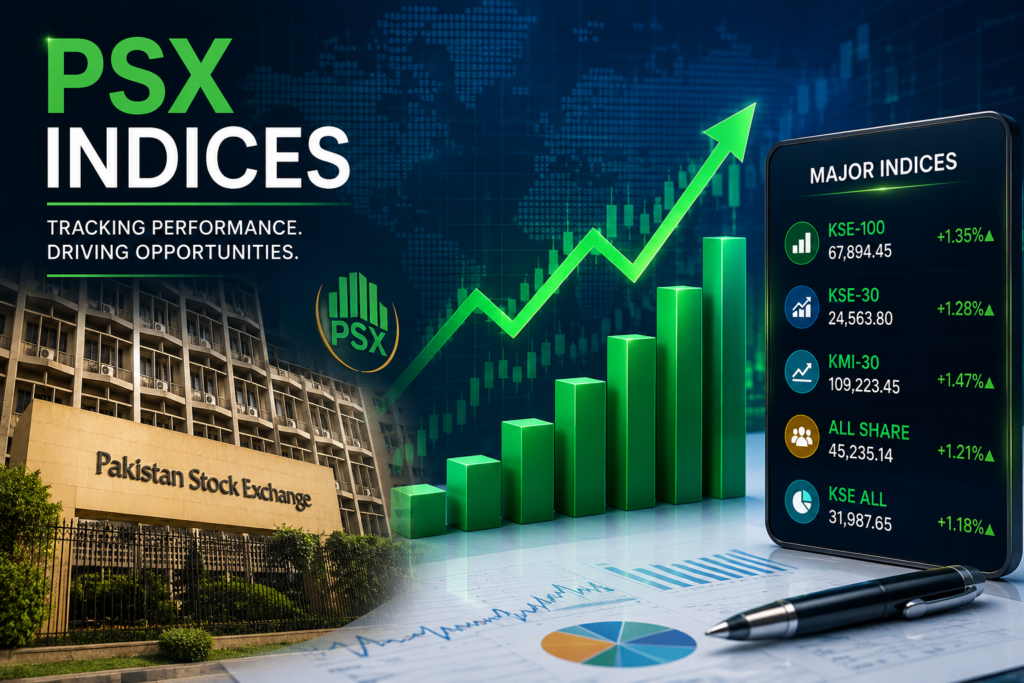
The PSX maintains a suite of indices, each tailored to different investor needs—whether you’re a beginner eyeing stable giants like Habib Bank Limited (HBL), a trader chasing liquid stocks like Pakistan Petroleum Limited (PPL), or a Shariah-conscious investor seeking halal options. Below, we delve into the major PSX indices, their makeup, and their unique strengths.
Major Indices of the Pakistan Stock Exchange
- KSE-100 Index
- Overview: Launched on November 1, 1991, the KSE-100 is the PSX’s flagship index and Pakistan’s most recognized market benchmark. It tracks the top 100 companies by market capitalization, accounting for roughly 85–90% of the PSX’s total market value. Iconic firms like Oil and Gas Development Company Limited (OGDC), Engro Corporation, Lucky Cement, and Meezan Bank feature prominently.
- Composition: The index ensures sectoral diversity by including one company from each of the PSX’s 37+ sectors (e.g., banking, cement, textiles) based on the highest free-float market cap within that sector. The remaining slots are filled by the largest companies overall, regardless of sector. It’s rebalanced quarterly (March, June, September, December) to reflect shifts in market leadership, with a base value of 1,000 points set in 1991.
- Strengths:
- Market Barometer: As the go-to indicator for Pakistan’s stock market, it mirrors the economy’s ups and downs—rising during infrastructure booms or export growth, and dipping amid political instability or currency depreciation.
- Stability and Depth: Dominated by blue-chip companies with strong fundamentals, it’s less volatile than smaller indices, offering a dependable gauge for cautious investors.
- Global Visibility: Previously part of the MSCI Emerging Markets Index (reclassified to Frontier Markets in 2021), it draws foreign institutional investors, enhancing liquidity and credibility.
- Historical Tracking: With decades of data, it helps investors analyze long-term trends, like the recovery post-2008 financial crisis or the 2020 COVID-19 dip.
- Importance: For beginners or conservative Pakistanis, the KSE-100 is a starting point to understand market sentiment and invest in top-tier stocks—either directly or via mutual funds like NIT’s KSE-100 tracker.
- KSE-30 Index
- Overview: Introduced on September 1, 2006, the KSE-30 is a more focused index, tracking the 30 most liquid and highly capitalized companies on the PSX. It emphasizes free-float market cap, featuring heavyweights like HBL, PPL, and Fauji Fertilizer Company (FFC).
- Composition: Unlike the KSE-100, it excludes total market cap and focuses solely on tradable shares, avoiding distortions from promoter-held stock. The index is rebalanced periodically (typically semi-annually) and uses a base value of 10,000 points from its launch. Eligible companies must rank among the top 100 by total market cap and meet liquidity thresholds (e.g., high trading volumes).
- Strengths:
- Liquidity Focus: Highlights stocks actively traded daily, making it a favorite for day traders and those seeking quick entry-exit opportunities.
- Sensitivity to Market Moves: With a smaller, elite pool, it reacts faster to economic shifts—say, an oil price surge boosting OGDC—offering real-time insights into big players’ performance.
- Purer Valuation: Free-float weighting ensures the index reflects investor sentiment more accurately, unscrewed by locked-in shares.
- Tradability: Its stocks are ideal for derivatives (if introduced) or active trading strategies due to their high volume.
- Importance: Suited for experienced investors or active traders in Pakistan who prioritize liquidity and want to capitalize on short-term market movements.
- KSE All Share Index
- Overview: The broadest PSX index, the KSE All Share encompasses every listed company—over 500 as of 2025—ranging from billion-dollar firms like Nestlé Pakistan to smaller players in textiles or pharmaceuticals.
- Composition: Weighted by total market capitalization (not free-float), it captures the entire PSX universe without sectoral or size filters. It’s recalculated daily based on closing prices, with no fixed base year but a dynamic point system.
- Strengths:
- Holistic Perspective: Provides a complete picture of the PSX, including small-cap and mid-cap stocks ignored by the KSE-100 or KSE-30, revealing broader market trends.
- Sectoral Diversity: Reflects Pakistan’s economic fabric—textiles (e.g., Gul Ahmed), agriculture (e.g., Fauji Fertilizer Bin Qasim), and tech (e.g., Systems Limited)—offering a true cross-section.
- Growth Opportunities: Highlights emerging companies that could become future KSE-100 stars, appealing to risk-tolerant investors hunting for undervalued stocks.
- Resilience Indicator: Shows how smaller firms weather economic shocks, complementing the top-heavy KSE-100.
- Importance: Ideal for long-term investors or researchers seeking exposure to niche sectors or untapped potential beyond the market’s giants.
- PSX-KMI All Share Index
- Overview: The PSX-KMI (KSE Meezan Index) All Share is a Shariah-compliant index covering all PSX companies adhering to Islamic finance principles—avoiding interest (riba), excessive uncertainty (gharar), and prohibited industries (e.g., alcohol, gambling).
- Composition: Includes firms like Meezan Bank, Mari Petroleum, and The Searle Company, screened annually by a Shariah advisory board. Companies must derive less than 5% of revenue from non-compliant sources and meet debt-to-asset ratio limits (below 37%).
- Strengths:
- Ethical Alignment: Resonates with Pakistan’s predominantly Muslim population, offering halal investment options that align profit with faith.
- Global Appeal: With Islamic finance booming (e.g., Gulf investments), it attracts Shariah-focused funds from abroad, boosting its stocks’ visibility.
- Financial Discipline: Features companies with low leverage, reducing bankruptcy risk and enhancing stability.
- Broad Coverage: Encompasses all Shariah-eligible PSX firms, providing diverse halal choices.
- Importance: A must for Shariah-conscious Pakistanis who want ethical investing without sacrificing growth, especially in a market where Islamic banking thrives.
- NITPGI (NIT Pakistan Gateway Index)
- Overview: Managed by the National Investment Trust (NIT), the NITPGI tracks a curated list of 10–15 high-quality companies with strong fundamentals, governance, and profitability—often overlapping with KSE-100 names like Engro or HBL.
- Composition: Selected based on earnings consistency, dividend history, and management quality, rather than just market cap. It’s rebalanced as needed to maintain its focus on value-driven firms.
- Strengths:
- Quality Emphasis: Prioritizes firms with proven track records, ideal for risk-averse investors seeking steady returns.
- Fund Benchmark: Serves as a model for NIT mutual funds, offering a disciplined, value-investing blueprint.
- Resilience: Less prone to speculative swings, providing a stable anchor during market turbulence (e.g., 2022 inflation spikes).
- Dividend Focus: Features companies like FFC or Colgate-Palmolive, known for regular payouts.
- Importance: Perfect for conservative Pakistanis or those investing via NIT funds, emphasizing reliability over high-risk growth.
Other Notable Indices
- KMI-30 Index: A subset of the PSX-KMI, it tracks the top 30 Shariah-compliant firms by free-float market cap (e.g., Fauji Cement, Systems Limited). It blends liquidity with ethics, launched in 2008 with a base of 10,000 points.
- OGTi (Oil & Gas Tradable Index): Focuses on energy leaders like OGDC, PPL, and Pakistan State Oil (PSO), reflecting Pakistan’s oil and gas sector—crucial amid energy crises and exploration booms.
- BKTi (Banking Tradable Index): Highlights top banks like MCB, UBL, and Bank Alfalah, underscoring the financial sector’s dominance (25–30% of PSX market cap).
These sectoral indices, introduced in recent years, cater to investors targeting specific industries driving Pakistan’s economy.
Why PSX Indices Matter
- Market Insight: The KSE-100’s 10% jump might signal a buying opportunity, while a KSE-30 drop could warn of profit-taking—guiding your timing.
- Investment Vehicles: Indices inspire funds like UBL’s KSE-100 ETF or NIT’s offerings, letting you invest broadly without stock-picking.
- Risk Calibration: The stable NITPGI contrasts with the volatile All Share, helping you match risk to your comfort level.
- Economic Reflection: A surging OGTi might reflect oil discoveries, while a KMI-30 rise signals Shariah sector strength—tying your investments to Pakistan’s pulse.
- Performance Yardstick: Beat the KSE-100’s 15% annual return, and you’re outperforming the market—a clear success metric.
Strengths of PSX Indices
- Diverse Scope: From the all-encompassing All Share to the niche BKTi, they cater to every strategy.
- Dynamic Updates: Quarterly or semi-annual rebalancing, keeps them current.
- Real-Time Access: Available on dps.psx.com.pk, broker apps, Websites or TV tickers, they’re at your fingertips.
- Local Context: Rooted in Pakistan’s realities—textiles, Islamic finance, energy—they’re more relevant than global indices like the S&P 500.
- Investor Education: Free PSX resources explain their mechanics, empowering novices.
Using Indices in Your Strategy
- Beginners: Buy KSE-100 stocks or funds for a safe start.
- Traders: Leverage KSE-30 or OGTi for liquid trades.
- Ethical Investors: Pick KMI-30 stocks for halal gains.
- Analysts: Study All Share for hidden gems (e.g., a small textile firm doubling in value).
Conclusion
The indices of the Pakistan Stock Exchange are your roadmap to financial success in a market brimming with potential. Whether it’s the KSE-100’s broad stability, the KSE-30’s trading agility, the All Share’s inclusivity, the KMI’s ethical focus, or the NITPGI’s quality bias, each offers unique strengths tailored to Pakistan’s economic landscape. For Pakistani investors, they simplify complexity, spotlight opportunities, and measure progress toward financial freedom. Track them daily on the PSX Data Portal, align them with your goals, and harness their insights to invest wisely. The PSX indices aren’t just numbers—they’re your key to unlocking a wealthier tomorrow. Start exploring now!