
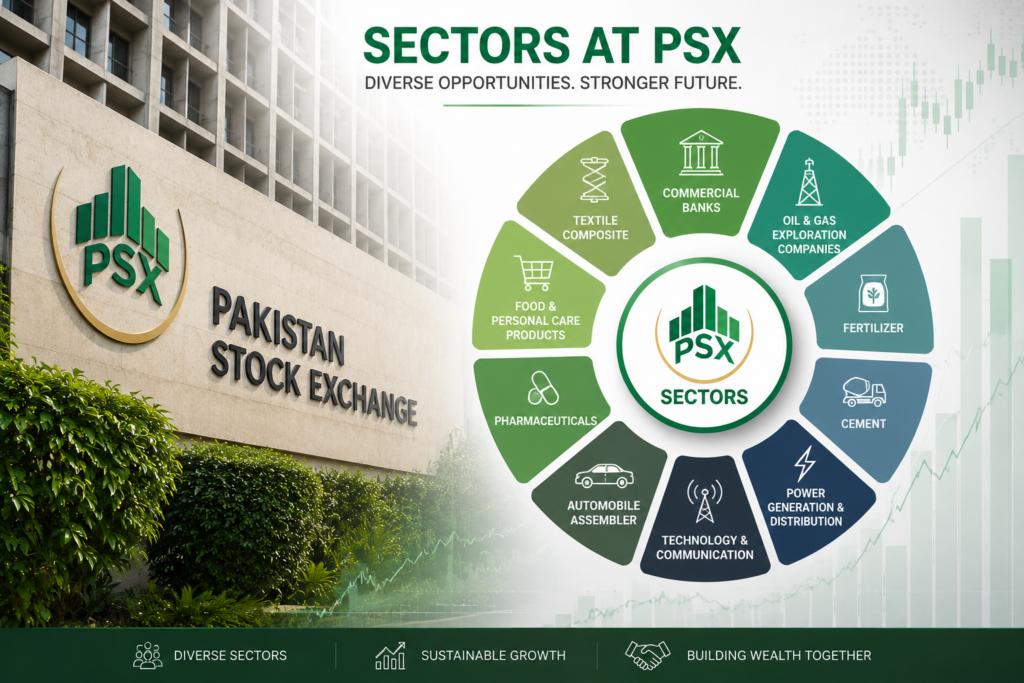
Sectors of the Pakistan Stock Exchange
The Pakistan Stock Exchange (PSX) is a vital hub for Pakistanis aiming to secure financial freedom through smart investing and strategic financial planning. As the country’s only stock market, it brings together over 500 listed companies, organized into more than 37 distinct sectors that mirror the diverse facets of Pakistan’s economy. These sectors—ranging from powerhouse financial institutions to volatile energy explorers and innovative tech firms—offer investors a broad spectrum of opportunities to grow wealth while managing risk. Understanding the differences between these sectors is key to building a balanced portfolio tailored to your financial goals. We’ll explore the major PSX sectors, unpack how they differ from one another, and explain the criteria used to differentiate them, empowering Pakistani investors to navigate the market with confidence.
Understanding PSX Sectors
A sector on the PSX is a category grouping companies with similar business activities, classified based on their primary source of revenue and operational focus. The PSX employs a structured classification system, inspired by international standards like the Global Industry Classification Standard (GICS), to organize its listed companies. This segmentation allows investors to pinpoint industries driving Pakistan’s economic growth, evaluate their performance, and diversify investments effectively. Sectors vary widely in market capitalization, growth potential, risk levels, and sensitivity to domestic and global factors, making them distinct building blocks for financial success. Whether you’re a beginner eyeing stable dividends or an experienced trader chasing high returns, the PSX’s sectoral diversity has something for you.
Major Sectors of the Pakistan Stock Exchange
The PSX features over 37 sectors, but here we’ll delve into some of the most prominent ones, detailing their characteristics, differences, and what sets them apart:
- Commercial Banks
- Overview: This sector encompasses major financial institutions like Habib Bank Limited (HBL), United Bank Limited (UBL), MCB Bank Limited, and Meezan Bank Limited, offering services such as savings accounts, loans, credit cards, and Shariah-compliant financing.
- Key Features: It’s one of the PSX’s largest sectors, contributing 25–30% of total market capitalization. Banks offer stable dividends (e.g., 5–8% yields), low volatility due to consistent demand, and resilience during economic downturns. Meezan Bank, for instance, thrives in Islamic banking, a growing niche in Pakistan.
- Differences: Unlike manufacturing sectors, banks generate revenue through interest margins (or profit-sharing in Islamic models) rather than producing goods. They’re heavily regulated by the State Bank of Pakistan (SBP), with performance tied to monetary policy (e.g., interest rate hikes in 2022–23). This contrasts with industrial sectors reliant on raw materials or exports.
- Economic Role: Banks fuel economic activity by lending to businesses and individuals, making them a backbone of financial stability.
- Oil and Gas Exploration
- Overview: Companies like Oil and Gas Development Company Limited (OGDC), Pakistan Petroleum Limited (PPL), and Mari Petroleum Company Limited focus on discovering and extracting oil and natural gas reserves.
- Key Features: High revenue potential (e.g., OGDC’s billion-dollar market cap), significant government stakes (OGDC and PPL are state-owned), and capital-intensive operations requiring advanced technology. Stocks soar with oil price spikes (e.g., 2022 global surge) but slump during oversupply.
- Differences: Unlike banks’ service-based model, this sector depends on natural resource extraction and global commodity prices, introducing higher volatility. It contrasts with domestic-focused sectors like cement, as its fortunes hinge on international markets and geopolitical events (e.g., OPEC decisions).
- Economic Role: Critical for Pakistan’s energy security, though hampered by depleting reserves and import reliance.
- Cement
- Overview: Includes industry leaders like Lucky Cement Limited, DG Khan Cement Company Limited, and Fauji Cement Company Limited, manufacturing cement for construction, housing, and infrastructure projects.
- Key Features: Cyclical growth tied to government spending (e.g., China-Pakistan Economic Corridor), moderate dividends (3–5%), and sensitivity to input costs like coal and electricity. Lucky Cement, a KSE-100 staple, exemplifies the sector’s scale.
- Differences: Unlike banks, cement firms produce physical goods, and their demand is domestic-driven rather than export-led (like textiles). They differ from oil and gas by relying on manufacturing processes rather than resource extraction, with less exposure to global price swings but more to local economic cycles.
- Economic Role: A barometer of infrastructure development, thriving during construction booms but vulnerable to slowdowns.
- Textile Composite
- Overview: Features firms like Nishat Mills Limited, Gul Ahmed Textile Mills Limited, and Interloop Limited, spanning spinning, weaving, dyeing, and garment production.
- Key Features: Pakistan’s largest export sector (60% of total exports), labor-intensive with thousands of workers, and volatile due to global cotton prices, trade policies (e.g., EU GSP+ status), and rupee depreciation. Nishat Mills, for example, balances domestic and export markets.
- Differences: Unlike cement’s local focus, textiles rely heavily on international demand, setting them apart from domestic-driven sectors. They’re less capital-intensive than oil and gas but riskier than banking due to currency fluctuations and competition from Bangladesh or India.
- Economic Role: A job creator and forex earner, pivotal to Pakistan’s trade balance.
- Food and Personal Care Products
- Overview: Home to multinationals like Nestlé Pakistan Limited, Colgate-Palmolive (Pakistan) Limited, and Unilever Pakistan Foods, producing essentials like milk, toothpaste, and soaps.
- Key Features: Stable demand (daily necessities), high profit margins (Nestlé’s billion-dollar valuation), and resilience to economic slumps. These firms benefit from strong branding and urban consumer bases.
- Differences: Unlike cyclical cement or export-led textiles, this sector thrives on consistent household consumption, distinguishing it from industrial or trade-dependent sectors. It’s less risky than oil exploration but lacks the explosive growth potential of tech.
- Economic Role: A defensive sector, buffering portfolios during recessions.
- Fertilizer
- Overview: Includes giants like Fauji Fertilizer Company (FFC), Engro Fertilizers Limited, and Fatima Fertilizer, producing urea and other inputs for agriculture.
- Key Features: Linked to Pakistan’s 20% agrarian GDP, supported by government subsidies (e.g., gas pricing), and steady rural demand. FFC offers reliable dividends (6–8%).
- Differences: Unlike consumer goods serving urban households, fertilizers cater to farmers, differentiating them from food products. They’re less export-oriented than textiles and more stable than oil, though gas supply disruptions pose risks.
- Economic Role: Vital for food security, supporting Pakistan’s agricultural backbone.
- Technology and Communication
- Overview: An emerging sector with companies like Systems Limited (IT services), Pakistan Telecommunication Company Limited (PTCL), and TRG Pakistan (tech outsourcing).
- Key Features: High growth potential (Systems Limited’s 2020s surge), driven by digitalization, exports (IT services to the US), and a young, skilled workforce. Volatility stems from global tech trends.
- Differences: Unlike cement or fertilizers’ physical output, tech is intangible and service-based, requiring less capital but more innovation. It contrasts with banking’s stability, offering higher risk-reward dynamics.
- Economic Role: A future driver, signaling Pakistan’s shift toward a knowledge economy.
- Power Generation and Distribution
- Overview: Features firms like The Hub Power Company (HUBCO), Kot Addu Power Company (KAPCO), and K-Electric Limited, generating and distributing electricity.
- Key Features: Regulated tariffs (NEPRA oversight), massive infrastructure investments, and challenges like circular debt (PKR 2 trillion+ in 2025). HUBCO’s coal plants exemplify diversification.
- Differences: Unlike tech’s flexibility, power relies on physical assets and government policies, contrasting with service sectors. It’s more stable than oil but less agile than banking due to regulatory constraints.
- Economic Role: Essential for industrial and domestic energy needs, though mired in inefficiencies.
- Tobacco
- Overview: Dominated by Pakistan Tobacco Company Limited (a British American Tobacco subsidiary) and Philip Morris (Pakistan), producing cigarettes and tobacco products.
- Key Features: High profitability (billion-dollar valuations), steady demand despite heavy taxes (70% of retail price), and ethical controversies.
- Differences: Unlike fertilizers’ agricultural focus or power’s utility role, tobacco serves a niche consumer base with limited growth but high margins. It’s less cyclical than autos but more scrutinized than food.
- Economic Role: A revenue generator for taxes, though socially debated.
- Automobile Assembler
- Overview: Includes Indus Motor Company (Toyota), Honda Atlas Cars, and Pak Suzuki Motor Company, assembling vehicles for domestic sale.
- Key Features: Cyclical, tied to consumer income, and hit by import duties and rupee falls (e.g., 2023 PKR depreciation doubled car prices). Indus Motor leads with Corolla sales.
- Differences: Unlike food’s necessity-driven demand, autos are discretionary, contrasting with essentials. They differ from cement by producing finished goods, not raw materials, and face higher volatility than banking.
- Economic Role: Reflects middle-class spending power, a growth indicator.
How Sectors Are Differentiated
The PSX distinguishes sectors using clear criteria, ensuring each represents a unique economic function:
- Primary Business Activity
- Defined by core operations: banks (HBL) lend, cement firms (Lucky) manufacture, tech companies (Systems Limited) code. This separates service providers from producers.
- Revenue Source
- Income streams vary—textiles (Nishat Mills) from exports, power (HUBCO) from tariffs, tobacco (Pakistan Tobacco) from sales. This differentiates global vs. local reliance.
- Economic Drivers
- Unique forces shape each: oil (OGDC) tracks crude prices, fertilizers (FFC) follow crop cycles, autos (Indus Motor) reflect consumer sentiment—unlike banks’ interest rate linkage.
- Risk and Volatility
- Risk profiles diverge—banking’s low volatility (UBL) vs. oil’s high swings (PPL), textiles’ currency risks (Gul Ahmed) vs. food’s stability (Nestlé). This guides risk tolerance.
- Market Size and Influence
- Banking and oil dominate (e.g., 50% of KSE-100 weight), while tech and autos are smaller but growing, affecting their PSX impact.
- Regulatory Environment
- Oversight varies—power (K-Electric) faces NEPRA, banks (MCB) follow SBP, textiles (Interloop) navigate trade laws—unlike less-regulated consumer goods.
- Asset Base
- Physical vs. intangible assets differentiate them: cement (DG Khan) needs factories, tech (TRG) relies on talent, banks (Meezan) manage capital—shaping investment needs.
Why Sector Differences Matter
- Diversification: Mixing banking (stability), tech (growth), and food (resilience) hedges against downturns.
- Targeted Growth: High-growth tech or oil contrasts with steady banking or fertilizers, matching your timeline.
- Economic Signals: Cement’s rise (CPEC) or textiles’ dip (export bans) guide sector picks.
- Risk Alignment: Low-risk food balances high-risk oil, fitting your comfort zone.
Conclusion
The sectors of the Pakistan Stock Exchange offer Pakistani investors a vibrant mosaic of opportunities, each distinct in purpose, risk, and potential. From banking’s steady dividends to oil’s volatile upside, textiles’ export flair to tech’s digital promise, these sectors reflect Pakistan’s economic heartbeat. By grasping their differences—rooted in business models, drivers, and regulation—you can craft a portfolio that leverages this diversity for financial freedom. Dive into our data portal, study these sectors, and invest with purpose. Your wealth-building journey begins with the PSX’s sectoral riches—explore them today!