
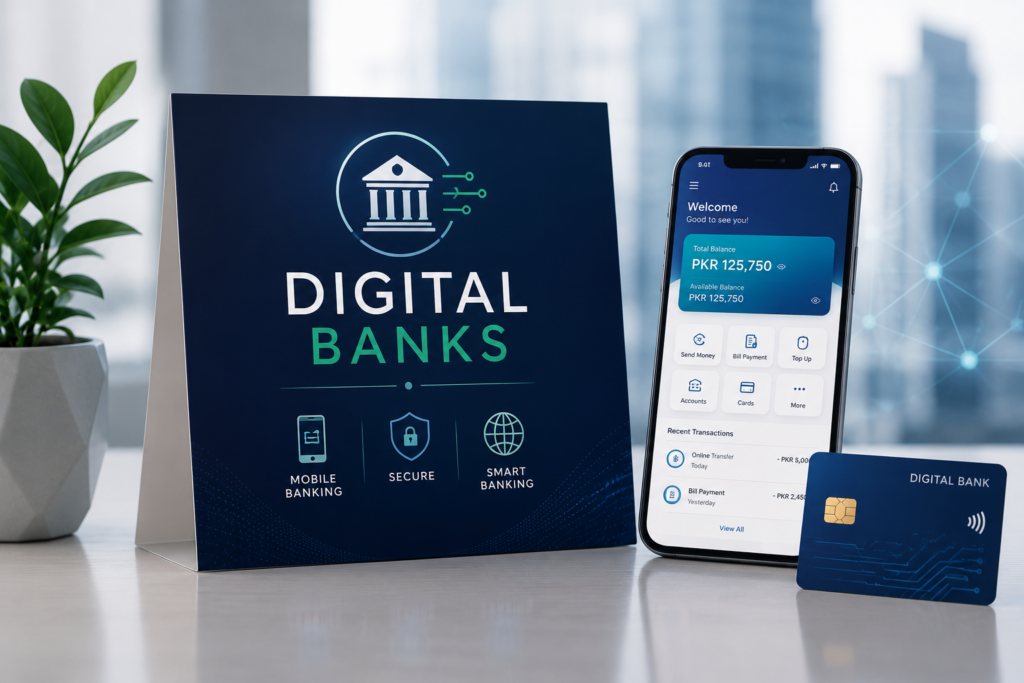
Digital Banks in Pakistan: Revolutionizing Financial Freedom
Pakistan’s financial sector is witnessing a paradigm shift with the advent of digital banks, a new breed of financial institutions that operate entirely online, redefining how individuals save, borrow, and invest in pursuit of financial freedom. For Pakistanis aiming to manage their finances smartly, digital banks fall under the “Banks” category as a modern, technology-driven alternative to traditional banking models. Unlike conventional banks with their extensive branch networks, Islamic banks rooted in Shariah principles, or microfinance banks targeting underserved communities, digital banks leverage cutting-edge technology to offer seamless, cost-efficient, and inclusive financial services. This article provides an in-depth exploration of digital banks in Pakistan, their operational mechanisms, key differences from other banking types, and how they empower users to achieve financial independence.
What Are Digital Banks?
Digital banks, often referred to as neobanks or virtual banks, are financial institutions that deliver banking services exclusively through digital channels—mobile apps, websites, and online platforms—without maintaining physical branches. In Pakistan, this category was formalized by the State Bank of Pakistan (SBP) with the introduction of the Licensing and Regulatory Framework for Digital Banks in January 2022. The framework aims to foster financial inclusion, encourage innovation, and meet the needs of a growing digital population.
The SBP categorizes digital banks into two types:
- Digital Retail Banks (DRBs): Focused on individual customers and small businesses, requiring a minimum paid-up capital of PKR 1.5 billion (escalating to PKR 4 billion within three years).
- Digital Full Banks (DFBs): Serving both retail and corporate clients, with higher capital thresholds (e.g., PKR 10 billion).
Unlike traditional banks, digital banks target Pakistan’s 76 million internet users and 194 million mobile subscribers, offering a low-cost, scalable model to bridge the gap for the 100 million unbanked adults. Their branchless nature makes them uniquely suited to a country where rural banking access remains limited.
How Digital Banks Work in Pakistan
Digital banks operate within Pakistan’s regulated financial ecosystem, blending advanced technology with SBP oversight to deliver efficient services. Here’s a detailed breakdown of their operations:
- Fully Digital Operations
Every aspect of banking—account opening, deposits, withdrawals, loans, and investments—is conducted online. For example, a user in any area can download an app, upload their CNIC and a selfie for biometric verification (via NADRA’s e-Sahulat), and open a savings account in under 10 minutes—no need to visit a branch or fill out paper forms. Transactions, such as transferring to a friend or paying a utility bill, are executed instantly via smartphone or laptop. - Technology-Driven Services
Digital banks harness artificial intelligence (AI), machine learning, and cloud computing to streamline processes and personalize offerings. A loan application might be approved in hours, with AI analyzing spending patterns from linked mobile wallets or credit scores from the SBP’s eCIB system—far faster than the days or weeks required by conventional banks. Push notifications alert users to save monthly or invest when markets dip, enhancing financial decision-making. - Funding and Revenue Model
Digital banks raise capital through customer deposits (e.g savings accounts), equity investments from venture capitalists or parent companies (e.g Telenor for Easypaisa), and loans from institutions like the Pakistan Microfinance Investment Company (PMIC). Without the overhead of physical branches—rent, staff salaries, or utilities—they keep costs low compared to conventional or Islamic banks. Revenue comes from transaction fees, profit margins on loans or subscription-based premium features (e.g budgeting tools). - Integration with Digital Ecosystem
Digital banks plug into Pakistan’s digital infrastructure, leveraging the SBP’s Raast instant payment system for free transfers and partnering with mobile wallets like JazzCash, Easypaisa, and Upaisa. A farmer in a rural area can deposit amount via a local agent and manage it online, while urban users link digital bank accounts to e-commerce platforms for purchases. Interoperability with the National Database and Registration Authority (NADRA) ensures secure identity verification. - Customer-Centric Approach
Free from legacy systems, digital banks design intuitive, user-friendly interfaces. A student can set a monthly savings goal, track spending with real-time analytics, or invest in a mutual fund—all within one app. Customer support operates 24/7 via AI chatbots or human agents reachable through WhatsApp or email, unlike branch-limited hours at traditional banks.
Key Digital Banks in Pakistan
As of April 2025, the SBP has issued licenses to trailblazers shaping Pakistan’s digital banking landscape:
- Mashreq Bank Pakistan: A UAE-based leader granted a restricted license in January 2025, Mashreq targets SMEs with business loans and savings accounts, building on its Middle Eastern success.
- Telenor Microfinance Bank (Easypaisa): Evolving from a mobile wallet with 25 million users, Easypaisa’s digital bank offers loans, savings accounts, and processes 4 million daily transactions (PKR 100 trillion annually).
- Hugo Bank: A consortium of Getz Bros, Muller & Phipps (M&P), and Atlas Consolidated, Hugo focuses on urban youth with investment accounts and a digital wallet for peer-to-peer transfers.
- KT Bank Pakistan: Backed by Kuda Technologies, Fatima Fertilizer, and The City School, KT targets rural agriculture (e.g tractor financing) and education (student loans).
- Raqami Islamic Digital Bank: A Kuwaiti-led Islamic bank, Raqami offers Shariah-compliant Mudarabah accounts and Murabaha financing, blending faith and technology.
How Digital Banks Support Financial Freedom
The rise of digital banks in Pakistanis transforming the way people manage money, save, and invest. Unlike traditional banks that rely on physical branches, digital banks operate mainly through mobile apps and online platforms—bringing financial services to your fingertips. For Pakistanis seeking financial freedom, digital banks provide an accessible, affordable, and smart way to take control of their money.
1. Easy Access to Banking Services
Digital banks eliminate the need to stand in long queues or travel miles to find a branch. With just a smartphone, users can:
- Open accounts instantly.
- Transfer money without fees (via platforms like Raast).
- Pay bills anytime, anywhere.
For rural communities in Balochistan, KPK, or interior Sindh—where conventional branches are scarce—digital banking means financial services are finally within reach.
2. Encouraging Smart Savings
Financial freedom starts with disciplined saving, and digital banks make this easier through:
- Automated savings features, where small amounts are set aside daily or weekly.
- Goal-based savings plans, helping users save for education, marriage, or business.
- Higher profit rates on digital-only accounts, since operational costs are lower.
These tools promote a saving culture, allowing even low-income users to build financial stability step by step.
3. Affordable Credit Options
Digital banks are introducing instant microloans and buy-now-pay-later (BNPL) services, giving individuals access to short-term credit without heavy paperwork. Whether it’s a student paying tuition, a shopkeeper stocking inventory, or a freelancer investing in tools, these facilities provide quick and convenient financing to grow income and assets.
4. Investment Opportunities Made Simple
Many digital banks in Pakistan are integrating with investment platforms, giving users direct access to:
- Sukuk and Islamic mutual funds.
- Stock market apps for halal trading.
- Green finance projects like renewable energy Sukuk.
This democratizes investing—allowing Pakistanis to start small and gradually build wealth.
5. Financial Inclusion for All
A significant portion of Pakistan’s population remains unbanked. Digital banks are breaking barriers by offering:
- Low-cost or zero-fee accounts with minimal documentation.
- Urdu-based mobile apps for accessibility.
- Services tailored for women, freelancers, farmers, and gig workers.
By bringing these groups into the financial system, digital banks are helping more Pakistanis participate in wealth creation.
6. Empowering with Financial Literacy
Some digital banks are going beyond transactions by offering educational tools within their apps. Gamified features encourage users to meet savings goals, while push notifications provide reminders about spending habits. For a country where financial literacy is low, this knowledge helps people make better financial decisions.
Challenges of Digital Banks in Pakistan
While digital banks are reshaping financial access, they also face challenges that need attention before the sector can reach its full potential.
1. Cybersecurity Risks
As banking shifts online, cybersecurity becomes a top concern. Protecting customer accounts, personal data, and transactions against fraud or hacking is a constant challenge. Any breach can erode trust, especially when people are still developing confidence in digital banking.
2. Low Digital Literacy
Despite Pakistan’s progress in education, digital literacy remains low—only about 34% of the population is digitally literate. Many potential users struggle with navigating apps, understanding online financial tools, or recognizing fraud. Without widespread digital education, adoption will remain uneven.
3. Patchy Internet Access
Digital banking relies on internet connectivity, but only about 60% of Pakistanis have reliable coverage. In rural areas, poor infrastructure means people cannot fully benefit from mobile banking apps or online financial services. Until connectivity gaps are bridged, a large portion of the population will remain excluded.
Opportunities on the Horizon
Despite these challenges, the growth potential for digital banks is massive:
- Mobile Penetration: With over 194 million mobile users, the foundation for digital banking adoption is already strong.
- Young Demographic: Pakistan’s population is predominantly young and tech-savvy, eager to embrace mobile-first financial solutions.
- Regulatory Support: The State Bank of Pakistan (SBP) is encouraging digital banking growth through initiatives like Raast, which processes over PKR 100 million daily in free transfers, and by issuingElectronic Money Institution (EMI) licensesto fintech startups.
Digital banks in Pakistan are at a turning point: while cybersecurity, literacy, and connectivity pose real hurdles, the opportunities created by mobile adoption, youthful energy, and SBP’s backing ensure the sector will continue to expand. If these challenges are addressed wisely, digital banks can accelerate financial inclusion and become a powerful engine for financial freedom.
The Road to Financial Freedom with Digital Banks
Digital banks in Pakistan are more than a convenience—they are a pathway to empowerment. They provide the tools to save wisely, borrow responsibly, invest confidently, and plan for the future—all from the palm of your hand.
Digital banks in Pakistan—branchless, low-cost, and innovative—contrast sharply with conventional banks’ physical networks, Islamic banks’ ethical focus, and microfinance banks’ rural outreach. Visit our website for updates and join Pakistan’s digital banking wave to secure your financial future today!
For Pakistanis seeking financial freedom, digital banks are proving that you don’t need wealth to start building wealth—you just need access. With smartphone penetration rising and government support for digital finance growing, the future of financial independence in Pakistan is undoubtedly digital.