
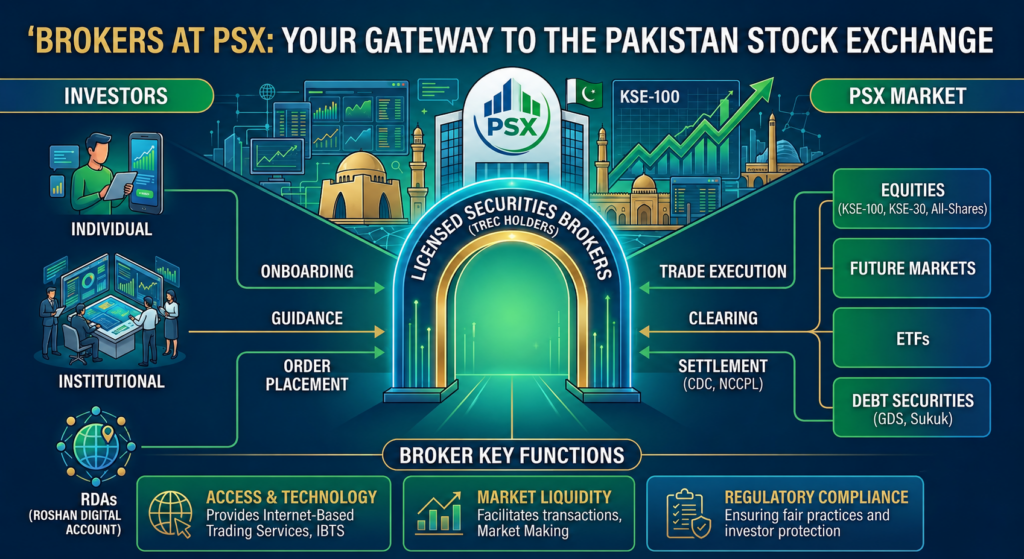
Listed Brokers at the Pakistan Stock Exchange
The Pakistan Stock Exchange (PSX) is a cornerstone of financial opportunity for Pakistanis seeking to invest smartly and achieve financial freedom. With over 500 companies listed across diverse sectors like banking, energy, and textiles, the PSX offers a wealth-building platform for everyone—from salaried workers in Karachi to entrepreneurs in Faisalabad. However, participating in this market requires a key player: the listed broker. These intermediaries are the lifeline of stock market trading, connecting individual investors to the exchange’s vast ecosystem. In this detailed article, we’ll explore who PSX-listed brokers are, how they operate, and why they’re indispensable for your investment journey in Pakistan.
Who Are Listed Brokers at the PSX?
Listed brokers at the Pakistan Stock Exchange are firms or individuals granted a Trading Rights Entitlement Certificate (TREC) by the PSX, following approval from the Securities and Exchange Commission of Pakistan (SECP). This certification allows them to act as authorized agents, executing buy and sell orders for investors on the PSX’s trading floor or electronic system. As of 2025, the PSX boasts over 50 active brokerage firms, ranging from industry giants like Arif Habib Limited and AKD Securities to smaller, retail-focused players like Abbasi and Company or BMA Capital Management.
These brokers vary in scope and clientele. Full-service firms like JS Global Capital cater to institutional investors and high-net-worth individuals, offering premium advisory services and research. Others, such as KASB Securities (via its KTrade platform), target everyday Pakistanis with user-friendly digital tools and low-cost trading options. Some brokers, like Al-Habib Capital Markets, operate branches in multiple cities—Karachi, Lahore, Islamabad—while others focus on online platforms accessible nationwide. Each broker must adhere to strict PSX and SECP regulations, ensuring they maintain transparency, financial integrity, and client trust.
How Do Brokers Work at the PSX?
Brokers are the engine behind every stock market transaction, streamlining a complex process into a seamless experience for investors. Here’s a step-by-step breakdown of their role:
- Account Setup and Market Access
Your journey begins by opening a trading account with a PSX-listed broker. This involves submitting your Computerized National Identity Card (CNIC), proof of address (e.g., an electricity bill), bank account details, and sometimes a photograph. The broker verifies these documents under SECP’s Know Your Customer (KYC) rules, a process that takes 2–5 business days. Once approved, you receive login credentials for their trading platform—whether it’s a web portal like Topline’s or a mobile app like KTrade—giving you direct access to the PSX’s real-time market. - Order Placement and Trade Execution
When you’re ready to invest—say, in shares of Meezan Bank or Lucky Cement—you instruct your broker to place an order. This can be done via phone, in person, or online. You’ll choose between:- Market Order: Buy or sell at the current market price.
- Limit Order: Set a specific price you’re willing to buy or sell at, executed only if the stock hits that level.
The broker enters your order into the PSX’s automated trading system, which matches it with a counterparty (buyer or seller). For example, if you buy 100 shares of Oil and Gas Development Company Limited (OGDC) at PKR 150 each, the broker ensures the trade is completed and notifies you instantly via email, SMS, or the platform.
- Custody, Settlement, and Record-Keeping
Post-trade, brokers manage the settlement process, which follows a T+1 cycle (settled one day after the transaction). They coordinate with:- Central Depository Company (CDC): Electronically transfers shares to your account (either a personal CDC Investor Account or a broker-managed sub-account).
- National Clearing Company of Pakistan Limited (NCCPL): Handles the financial side, ensuring funds move from your account to the seller’s.
Brokers also track dividends, bonus shares, or rights issues from companies you’ve invested in, depositing payouts into your linked bank account. They provide monthly or quarterly statements detailing your portfolio’s performance.
- Research, Analysis, and Advisory Services
Many PSX brokers offer value-added services beyond trade execution. Firms like Arif Habib Limited publish in-depth reports on sectors like cement (e.g., DG Khan Cement’s outlook) or energy (e.g., Mari Petroleum’s growth potential), often in Urdu and English. They analyze macroeconomic factors—interest rates, inflation, rupee stability—and recommend stocks suited to your goals. For instance, a broker might suggest Nishat Mills for export-driven growth or Systems Limited for tech exposure, tailoring advice to Pakistan’s unique market dynamics. - Fee Structure and Revenue
Brokers earn through commissions, typically 0.1–0.5% of each trade’s value (e.g., PKR 50 on a PKR 10,000 transaction) or a flat fee. Additional charges include CDC annual fees and taxes collected for the government—15% withholding tax on dividends (30% for non-filers) and capital gains tax (10% if sold within a year for filers). Transparent brokers display these costs upfront, helping you calculate net returns. - Technology and Innovation
Modern brokers leverage technology to enhance trading. Platforms like AKD Trade offer live PSX data (e.g., KSE-100 Index updates), charting tools, and mobile apps compatible with Android and iOS. Some, like BMA Capital, provide algorithmic trading options for advanced users, while others integrate with Roshan Digital Accounts for Non-Resident Pakistanis (NRPs).
The Importance of Brokers in Stock Market Trading
Brokers are more than facilitators—they’re the backbone of the PSX, offering critical services that empower investors. Here’s why they’re vital:
- Gateway to the Market
The PSX restricts direct trading to TREC holders, making brokers your only entry point. Whether you’re in a bustling city or a rural area with internet access, brokers provide the infrastructure—platforms, accounts, and connectivity—to trade stocks like Pakistan Tobacco or Nestlé Pakistan. - Knowledge and Strategic Insight
Pakistan’s stock market can be daunting, with volatility driven by political shifts, energy crises, or global trade dynamics. Brokers bridge this gap with expertise. For example, during a construction boom, they might highlight cement stocks like Lucky Cement, explaining how government projects boost demand. Their research helps you avoid speculative traps—common in Pakistan’s rumor-driven retail market—and focus on fundamentals. - Risk Mitigation Tools
Brokers offer features like stop-loss orders (e.g., sell if a stock drops 5%) to limit losses in a downturn. For advanced investors, some provide margin trading—borrowing funds to amplify investments—though this comes with higher risk. They also educate you on diversification, suggesting a mix of banking (e.g., HBL), energy (e.g., PPL), and consumer goods (e.g., Colgate-Palmolive) to balance your portfolio. - Ensuring Trust and Compliance
Regulated by the SECP and PSX, brokers uphold market integrity. They prevent fraud by securing your shares with the CDC and provide auditable records of every transaction. This is crucial in a market where historical scams (e.g., the 2008 crash) have wary investors seeking reliability. Brokers also handle tax reporting, ensuring compliance with Federal Board of Revenue (FBR) rules. - Driving Economic Growth
By facilitating trades, brokers channel savings into productive investments. When you buy shares in an IPO—help companies raise capital for expansion, creating jobs and boosting Pakistan’s GDP. This ripple effect ties your financial success to national progress.
Notable PSX Brokers and Their Offerings
The full list is available on www.psx.com.pk under “Brokerage Firms.”
Choosing a Broker: What to Consider
Your ideal broker depends on your profile:
- Beginners: Seek low-cost, educational brokers like KTrade or Abbasi and Company.
- Active Traders: Prioritize speed and tools with AKD or Topline.
- Shariah Investors: Opt for Islamic-focused brokers like Meezan Bank’s trading arm.
- Rural Investors: Choose online-first brokers with strong apps.
- NRPs: Look for Roshan Digital compatibility (e.g., Arif Habib).
Verify their SECP registration, compare fees, test customer support (call or email them), and ensure platform reliability during PSX hours.
Challenges and Risks
Not all brokers are equal—some charge steep fees (e.g., commissions) that erode small profits. Others lack responsive support, critical when markets crash or orders fail. Pakistan’s economic volatility—think IMF bailouts or oil price shocks—heightens reliance on broker guidance, yet some may push risky stocks for higher commissions. Always cross-check advice with PSX Data Portal (dps.psx.com.pk) data and beware of unregistered “advisors” posing as brokers.
Conclusion
Listed brokers at the Pakistan Stock Exchange are your trusted allies in the quest for financial freedom. They provide the access, expertise, and security needed to navigate a market brimming with potential—from billion-dollar giants like OGDC to emerging stars like Systems Limited. Whether you’re investing PKR 5,000 or PKR 5 million, a reputable broker transforms the PSX into a tool for wealth creation. Research your options, pick a broker aligned with your goals, and step confidently into Pakistan’s stock market. Your financial future starts with the right partner—choose wisely!