
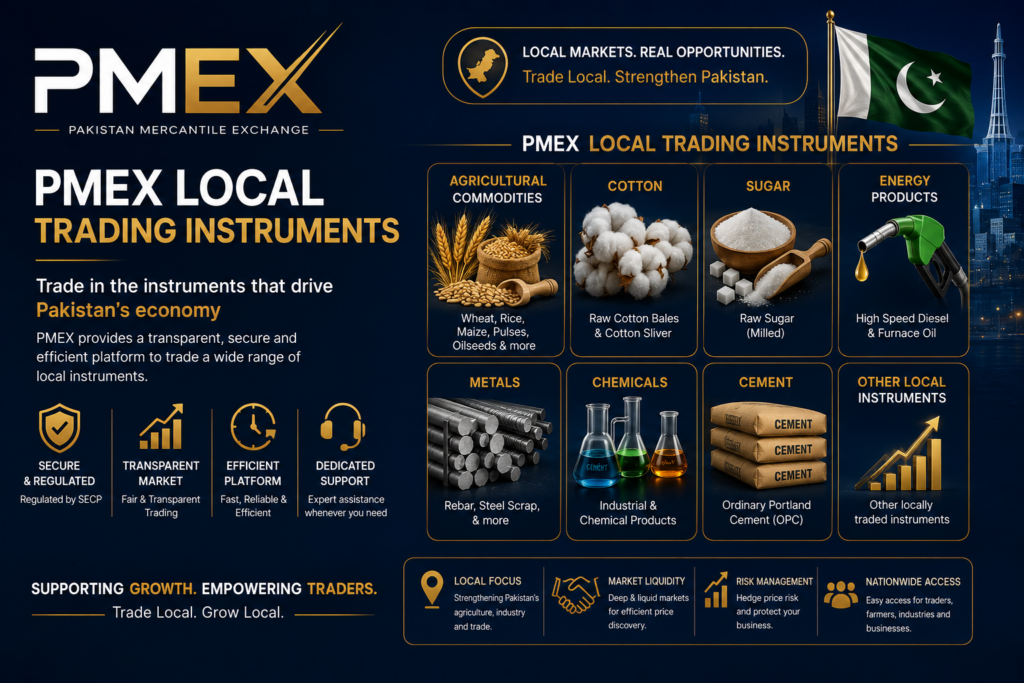
Local Trading Instruments at PMEX
Empowering Pakistan’s Commodity Market Through Innovation and Accessibility
Introduction: Strengthening Pakistan’s Local Commodity Ecosystem
The Pakistan Mercantile Exchange (PMEX) doesn’t just connect investors to global markets, it also provides a robust platform for local commodity trading, supporting Pakistan’s domestic producers, traders, and investors.
Through locally listed instruments such as Gold, Agriculture Commodities, and Electronic Warehouse Receipts (EWRs), PMEX has created a transparent, technology-driven marketplace that promotes financial inclusion, price stability, and wealth creation within Pakistan.
These local instruments are particularly beneficial for farmers, jewelers, investors, and small businesses, helping them hedge risks, gain liquidity, and participate in the formal economy — essential steps toward financial independence.
1. Gold: The Local Standard for Stability and Growth
Gold holds a special place in Pakistan’s economy — it’s both a cultural asset and a trusted store of value. PMEX allows Pakistanis to trade and invest in local gold contracts that are priced and settled in Pakistani rupees, making gold trading easier and more accessible.
PMEX Gold Contracts Include:
- Gold 1 Tola, 10 Tola, and 1 Ounce Contracts
- Deliverable Gold Contracts (settled through PMEX-approved vaults)
Why Trade Gold Locally on PMEX?
- Price Transparency: Prices reflect both local demand and global market trends.
- Hedging Against Inflation: Gold protects savings when the rupee weakens.
- Accessibility: Small contracts (1 tola) allow entry for retail investors.
- Physical Settlement Option: Investors can take delivery of gold if desired.
Example:
A jeweler in Karachi can lock in gold prices via a PMEX deliverable contract, protecting business margins from price spikes — a practical hedge against volatility.
List of Metals Instruments Available for Trading (local)
| Gold | PMEX One Tola Gold Futures Contract | |
| PMEX 50 Tola Gold Futures Contract | ||
| PMEX 100 Tola Gold Futures Contract | ||
| PMEX Gold 100 gms Futures Contract | ||
| PMEX Kilo Gold Futures Contract | ||
| PMEX Mini Gold Futures Contract | ||
| PMEX Milli Tola Gold Futures Contract | ||
2. Agriculture: Building Wealth Through Pakistan’s Core Sector
Agriculture is the backbone of Pakistan’s economy, employing millions and contributing significantly to exports. PMEX enables farmers, processors, and investors to trade agricultural commodities transparently, bringing modern finance to rural and semi-urban economies.
Key Agricultural Instruments at PMEX
- Rice
- Wheat
- Sugar
- Red Chilli
- Palm Oblein
How PMEX Supports the Agri Sector
- Price Discovery: Farmers can know the fair value of crops before selling.
- Hedging Opportunities: Lock in future prices to protect income from market drops.
- Market Linkage: Connects farmers directly with processors and exporters.
- Transparency: Electronic trading removes middlemen, ensuring fair pricing.
Example:
A rice miller in Punjab can hedge against falling rice prices by taking a short position in rice futures — ensuring predictable profits even in a volatile market.
List of Agriculture Instruments Available for Trading (local)
| Red Chilli | PMEX Investor Trading Guidelines for Red Chilli English |
| PMEX Red Chilli Trading Presentation | |
| Red Chilli FAQs | |
| Future Contracts | PMEX Dandicut (Longi) Red Chilli A Futures Contract |
| PMEX Dandicut (Longi) Red Chilli A+ Futures Contract | |
| PMEX Dandicut (Longi) Red Chilli B Futures Contract | |
| PMEX Hybrid Red Chilli 1-A Futures Contract | |
| PMEX Hybrid Red Chilli 1-B Futures Contract | |
| PMEX Hybrid Red Chilli 1-C Futures Contract | |
| PMEX Hybrid Red Chilli 2-A Futures Contract | |
| PMEX Hybrid Red Chilli 2-B Futures Contract | |
| PMEX Hybrid Red Chilli 2-C Futures Contract | |
| PMEX Hybrid Red Chilli 3-A Futures Contract | |
| PMEX Hybrid Red Chilli 3-B Futures Contract | |
| PMEX Hybrid Red Chilli 3-C Futures Contract | |
| Weekly Contracts | PMEX Hybrid Red Chilli 1-A Weekly Contract |
| PMEX Hybrid Red Chilli 1-B Weekly Contract | |
| PMEX Hybrid Red Chilli 1-C Weekly Contract | |
| PMEX Hybrid Red Chilli 2-A Weekly Contract | |
| PMEX Hybrid Red Chilli 2-B Weekly Contract | |
| PMEX Hybrid Red Chilli 2-C Weekly Contract | |
| PMEX Hybrid Red Chilli 3-A Weekly Contract | |
| PMEX Hybrid Red Chilli 3-B Weekly Contract | |
| PMEX Hybrid Red Chilli 3-C Weekly Contract | |
| PMEX Red Chilli Weekly (Grade A) Futures Contract | |
| PMEX Red Chilli Weekly (Grade A+) Futures Contract | |
| PMEX Red Chilli Weekly (Grade B) Futures Contract | |
| Rice | PMEX-IRRI-6 Rice Futures Contract |
| PMEX-Weekly IRRI-6 Rice Futures Contract | |
| Wheat | PMEX Wheat ( Grade A+) Weekly Futures Contract |
| PMEX Wheat (Grade A) Weekly Futures Contract | |
| Palm Olein | PMEX RBD PALM OLEIN Futures Contract |
| Sugar | PMEX Sugar Futures Contract |
3. Electronic Warehouse Receipts (EWRs): Turning Stored Crops into Cash
The Electronic Warehouse Receipt (EWR) system is one of PMEX’s most transformative innovations for Pakistan’s agriculture sector. It allows farmers and traders to digitize their stored commodities and use them as tradable and financeable assets.
What is an EWR?
An Electronic Warehouse Receipt represents ownership of commodities (like wheat, rice, or maize) stored in PMEX-accredited warehouses.
The EWR acts as a digital proof of ownership, verified and tradable on PMEX.
Benefits of EWRs
- Instant Liquidity: Farmers can sell or pledge EWRs to get financing without selling crops at low prices.
- Price Advantage: Allows farmers to wait for better market prices.
- Transparency & Security: Every transaction is traceable and regulated.
- Integration with Banks: EWRs are accepted as collateral by banks, unlocking credit for farmers and traders.
Example:
A maize farmer in Sindh stores 100 bags in a PMEX-accredited warehouse and receives an EWR. Instead of selling immediately at harvest when prices are low, the farmer can get financing from a partner bank, wait a few months, and sell the crop when market prices rise — maximizing returns.
List of Electronic Warehouse Receipts(EWRs) Available for Trading (local)
| PMEX Long Grain Paddy |
| PMEX Super Basmati Paddy |
| PMEX Long Grain Milled Raw Rice |
| PMEX Super Basmati Milled Raw Rice |
| PMEX Super Basmati Brown Raw Rice |
| PMEX Yellow Maize |
| PMEX Kainat Basmati Paddy 1121 |
| PMEX Kainat 1121 Basmati Milled Steamed Raw Rice |
Why Local PMEX Instruments Are a Better Choice for Trading
Local trading instruments on PMEX offer a unique blend of accessibility, stability, and national economic value. Here’s why they can be a smarter option for traders and investors in Pakistan:
| Advantage | Impact on Financial Independence |
| Low Entry Barriers | Start trading with small margins — ideal for students, farmers, and small investors. |
| Local Currency Contracts | Avoid foreign exchange risk; all trades in PKR. |
| Real Economic Linkages | Supports Pakistan’s gold, agriculture, and farming sectors directly. |
| Transparency & Regulation | SECP oversight ensures trust and fair trading. |
| Wealth Diversification | Adds tangible assets like gold and crops to your portfolio. |
| Empowerment for Rural Traders | EWRs bring farmers into the digital economy, creating financial inclusion. |
In Simple Terms:
Local PMEX instruments allow Pakistanis to invest in what they understand best — gold, crops, and commodities — while enjoying the benefits of digital access, liquidity, and financial growth.
Conclusion: Building Local Wealth through Smart Commodity Trading
The local trading instruments at PMEX represent more than investment tools — they’re part of Pakistan’s movement toward a modern, inclusive, and self-sustaining financial system.
From gold investors in urban centers to farmers in Sindh and Punjab, PMEX’s local platform helps individuals convert effort and savings into real financial growth.
By trading gold, agriculture, or EWRs, you’re not just investing — you’re contributing to a stronger, more resilient Pakistani economy while taking confident steps toward financial freedom.