
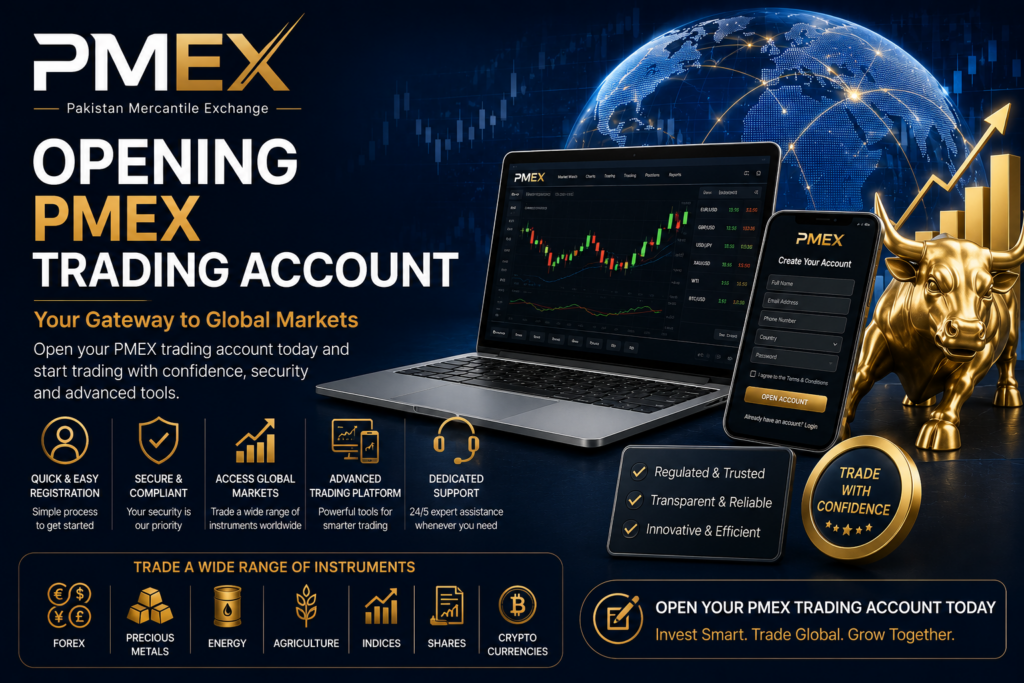
How to Open a PMEX Trading Account and Start Trading in Pakistan
A Step-by-Step Guide for New Investors to Begin Commodity Trading via Pakistan Mercantile Exchange
Introduction: Trading Made Simple
The Pakistan Mercantile Exchange (PMEX) is the country’s first and only regulated commodity and futures exchange, providing investors the opportunity to trade in gold, silver, crude oil, agricultural products, and currencies — all through a secure, digital platform.
For anyone aiming to diversify investments and build long-term financial freedom, opening a PMEX trading account is a smart first step. This guide walks you through how to open an account, what documents you need, and how trading works — whether you’re a beginner or an experienced investor.
Step 1: Understanding the PMEX Account
A PMEX trading account allows individuals or institutions to participate in buying and selling futures contracts for various commodities and assets.
These contracts represent an agreement to buy or sell a commodity at a future date — at prices determined today. You can profit when prices move in your favor, or use these contracts to hedge against inflation and market risks.
Types of PMEX Accounts
PMEX accounts are generally opened through licensed brokers or member institutions, which connect traders to the exchange. There are two main categories:
- Individual Account: For personal trading and small investors.
- Corporate Account: For companies and business entities looking to hedge commodity risks.
Step 2: Choose a PMEX-Authorized Broker
PMEX operates through a network of SECP-approved brokers and Trading Right Entitlement Certificate (TREC) holders. These brokers serve as intermediaries between you and the exchange.
Some of the well-known PMEX brokers include:
- AKD Securities Limited
- JS Global Capital Limited
- MRA Securities Limited
- Next Capital Limited
- Topline Securities
Before selecting a broker:
✅ Check their registration status on the official PMEX website: www.pmex.com.pk
✅ Compare account opening requirements, brokerage fees, and digital platforms offered.
✅ Prefer brokers offering online trading portals or mobile apps for convenience.
Step 3: Gather the Required Documents
To open a PMEX trading account, you’ll need to submit specific documents for identity verification, compliance, and KYC (Know Your Customer) purposes.
Documents Required for Individuals
- Copy of CNIC or NICOP (front and back)
- Recent passport-size photograph
- Proof of income or employment (e.g., salary slip or bank statement)
- Proof of address (utility bill or tenancy agreement)
- Filled PMEX Account Opening Form (provided by the broker)
- Zakat Declaration Form (if applicable)
Documents Required for Corporate Accounts
- Certificate of Incorporation
- Memorandum and Articles of Association
- Board Resolution authorizing trading on PMEX
- CNIC copies of directors and authorized signatories
- NTN Certificate and company bank details
Step 4: Complete the Account Opening Process
Once you’ve selected a broker and gathered the documents, the account opening process involves:
- Submission of Documents:
Send scanned or physical copies of your documents to your broker. - Verification and Compliance:
The broker verifies your identity and submits your data to PMEX and SECP for approval. - Account Activation:
After successful verification, your trading account and login credentials are issued. - Deposit Initial Margin:
You’ll need to deposit a margin amount (usually a small percentage of your total trade value). This margin acts as collateral for your trades and varies depending on the instrument you want to trade — for example, gold, oil, or currency contracts.
Step 5: Logging into the PMEX Trading Platform
After your account is activated, you’ll receive access credentials for your broker’s online trading system, which connects directly to PMEX.
Most brokers use PMEX-approved platforms such as:
- MetaTrader 5 (MT5)
- NextView
- PMEX Trader
- Broker’s proprietary web or mobile apps
Through these platforms, you can:
- View live market prices
- Place buy/sell orders
- Set stop-loss or limit orders
- Monitor your portfolio and account balance
Step 6: How Trading on PMEX Works
PMEX trading is straightforward once you understand the process.
1. Market Selection
Choose your preferred asset class:
- Gold & Silver – Safe haven and inflation hedge
- Crude Oil – Linked to global energy prices
- Agriculture (Rice, Wheat, Sugar) – Supports local commodities
- Currencies (USD/PKR, EUR/PKR) – Hedge against rupee depreciation
2. Order Placement
Decide whether you want to buy (long) or sell (short) a futures contract based on your price outlook.
3. Margin Requirement
Deposit a small fraction (margin) of the total contract value to initiate the trade.
4. Daily Mark-to-Market Settlement
At the end of each trading day, PMEX automatically adjusts your account for profit or loss based on price movement.
5. Trade Closing or Delivery
You can close your position anytime before expiry to realize profits (cash settlement) or take physical delivery (for certain commodities like gold).
Step 7: Managing Risk and Returns
Trading commodities involves both opportunity and risk. To trade successfully:
- Always use stop-loss orders to limit potential losses.
- Avoid over-leveraging; trade within your capital limits.
- Keep track of market news—global events can affect prices.
- Start small and scale up gradually as you gain experience.
- Diversify across multiple commodities to balance risk.
Step 8: Withdrawing Profits
Profits can be withdrawn directly into your linked bank account through your broker’s platform.
Withdrawals usually take 1–2 working days after settlement.
Step 9: Continuous Learning and Strategy Building
PMEX regularly conducts webinars, workshops, and market awareness sessions for traders. You can access free learning material at www.pmex.com.pk.
To achieve long-term success:
- Track daily market reports and economic indicators.
- Learn about technical and fundamental analysis.
- Build a trading plan with clear goals and risk limits.
Why Trading on PMEX Matters for Financial Freedom
Trading on PMEX helps investors move beyond static savings into active wealth generation. It offers:
- Diversified investment opportunities beyond stocks and property.
- Inflation protection through commodities like gold and oil.
- Global exposure from within Pakistan’s regulated system.
- Accessibility — you can trade online from anywhere, even with limited capital.
When managed responsibly, PMEX trading can become a powerful pillar of your financial freedom plan, complementing savings, mutual funds, and term deposits.
Quick Recap: Opening a PMEX Trading Account
| Step | Action | Details |
| 1 | Select Broker | Choose a SECP-licensed PMEX broker. |
| 2 | Submit Documents | CNIC, photo, proof of income, and address. |
| 3 | Account Verification | Broker completes KYC and compliance. |
| 4 | Deposit Margin | Minimum margin set by contract type. |
| 5 | Start Trading | Access platform, place orders, monitor performance. |
| 6 | Withdraw Profits | Transfer earnings to your linked bank account. |
Conclusion: Your First Step Toward Smart Investing
Opening a PMEX trading account is more than just entering the commodity market — it’s a gateway to financial empowerment. Whether you’re trading gold to hedge inflation, currencies for diversification, or oil for global exposure, PMEX offers a transparent, regulated, and digital ecosystem for Pakistani investors.
Start small, trade smart, and let your financial freedom journey begin today.
👉 Visit www.pmex.com.pk to explore brokers, market data, and training resources.